Reneau
Dubberley
Wood
Turner
Reneau
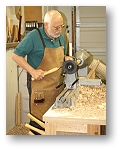
Dubberley spent his professional career designing precision machinery for
manufacturing. Now retired, he combines his vocation, functional design,
with two life-long hobbies, nature studies and woodworking. The combination
of the unique one-of- a- kind markings that nature imposes on wood and
Dubberley’s skill at precision turning results in the creation of a functional
artistic form.
With
over forty years experience in working with wood, he is able to envision
the design and function possibilities that are locked in a tree.
The actual turning is a dynamic process--- the natural figuring in the
wood evolves into a functional form.
The
tree sections used for turning are salvaged from trees that otherwise would
end up in the landfill. Friends and neighbors are eager to alert Dubberley
when they have a downed tree. His labor to cut up and remove usable wood
is free to the owner. The environment also benefits by reducing the
amount of wood going to the landfill. He salvages all usable logs.
Downed
trees are gathered while they have very high moisture content. The
ends of each log are sealed to retain moisture so that the log will not
dry out and split. Log sections are turned while green. The turnings
then dry to a finished shape. The non-uniform shrinkage of wood in the
radial and lateral directions causes the finished piece to develop a unique
natural shape.
Dubberley
uses wood that has natural defects. One favorite wood is elm, especially
trees that are attacked by the Dutch elm disease. The dark stain from the
disease randomly marks the beautiful close grain of elm. The stain highlights
new patterns in the grain that combine with the vessel’s form to make uniquely
beautiful bowls, vases, and platters.
Insects,
especially the ambrosia beetle, leave their design on ash maple. The beetle
leaves not only a hole, but also random dark stains that can be accentuated
by careful turning.
Mold
and bacteria are present in wood as it decays. The resulting patterns
of black streaks throughout the wood, known as spaulting, add an additional
design factor to a turned object.
Other
interesting natural markings are made by the contrast between sapwood and
heartwood, especially visible in cherry and walnut trees. The tree’s natural
burls and branching, as well as scars left from storm damage, add natural
elements to Dubberley’s carefully crafted design.
All
of the turnings have a two-fold purpose—artistic display and functional
use.
|